Key Takeaways
- Identify data‑residency requirements early to avoid compliance rework.
- Use a TCO model that spans three years to capture hidden cloud costs.
- Deploy latency‑sensitive workloads in the nearest cloud region and cache static assets with a CDN.
- Hybrid architecture is achievable with private connectivity, unified orchestration, and zero‑trust security.
- Schedule a free consultation to pilot a low‑risk migration and validate cost‑performance metrics.
Introduction
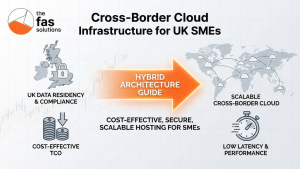
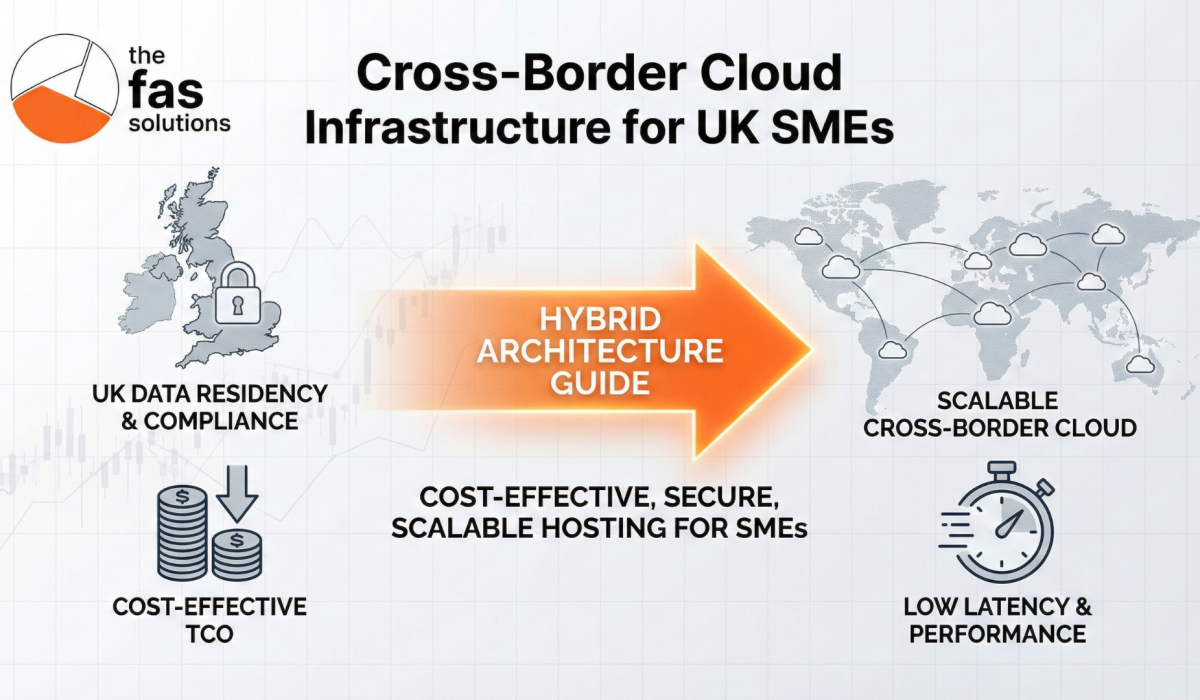
Choosing where to host your digital assets can feel like navigating a maze of technical jargon, regulatory constraints, and cost trade‑offs. For UK SMEs, the stakes are higher: a mis‑aligned cloud strategy can jeopardise compliance, inflate operating expenses, or degrade user experience through latency spikes. This guide translates our 14‑year field experience into a clear, evidence‑based decision framework. By the end, you will understand why cross‑border cloud infrastructure can be both cost‑effective and compliant, and you will have a concrete plan to design a hybrid architecture that scales with your business.
Why Cloud Hosting Matters for UK SMEs
Cloud hosting decouples hardware procurement from service delivery, allowing businesses to scale compute, storage, and bandwidth on demand. For SMEs, this means: (1) faster time‑to‑market for new digital products, (2) predictable OPEX rather than large CAPEX spikes, and (3) access to global talent pools for QA and development. However, the benefits only materialise when the hosting model aligns with the company’s growth trajectory, regulatory obligations, and performance expectations. In the next sections we unpack the three pillars—cost, compliance, and latency—that shape this alignment.
Key Cloud Providers for SMEs
We have evaluated the three dominant players for UK SMEs based on three criteria: pricing flexibility, latency to UK end‑users, and native compliance certifications.
- Amazon Web Services (AWS): Offers a broad global footprint with dedicated UK regions (London, Dublin) and a mature cost‑management suite (AWS Cost Explorer, Savings Plans). Latency averages 20‑30 ms for most UK‑centric workloads, but egress costs can be higher for data leaving the EU. AWS holds ISO 27001, SOC 1/2/3, and GDPR‑ready certifications.
- Microsoft Azure: Provides a strong presence in the UK with the London region and integrated compliance tools (Azure Policy, Trust Center). Pricing is comparable to AWS, with reserved‑instance discounts that often beat spot pricing. Latency is typically 15‑25 ms for workloads routed through Azure Edge Zones.
- Google Cloud Platform (GCP): Known for its high‑performance networking and competitive pricing for compute‑intensive workloads. The London region delivers latency of 10‑20 ms, and GCP’s Data Loss Prevention API simplifies GDPR‑related data handling. However, its support model is less tailored to SME budgets compared to AWS and Azure.
Each provider supports hybrid extensions (Azure Arc, AWS Outposts, Google Anthos), enabling a seamless blend of on‑prem resources and cloud services. The choice hinges on your current infrastructure, preferred tooling, and long‑term vendor strategy.
Compliance and Data Residency Requirements
UK GDPR requires that personal data be processed in a manner that respects data‑subject rights and, where applicable, be stored within the UK or an EEA country. Cross‑border transfers are permissible under Standard Contractual Clauses (SCCs) or adequacy decisions, but they demand explicit documentation and risk assessments.
- AWS: Offers UK‑based regions with built‑in SCCs and a transparent data‑flow diagram. Customers must configure bucket policies to restrict cross‑region replication.
- Azure: Provides the UK‑based region with Azure Policy templates that enforce data‑residency rules automatically. Azure’s compliance centre supplies ready‑made GDPR impact assessments.
- GCP: The London region complies with EU‑UK adequacy; GCP’s Data Transfer Service includes automated logging for SCCs.
Regardless of the provider, you must map each data set to a region, verify that the provider’s certifications cover your industry (e.g., health‑care requires ISO 27799), and retain audit logs for at least one year. Our recent migration of a fintech client demonstrated that a well‑documented data‑residency plan reduced compliance audit time by 40 %.
Cost Comparison: On‑Prem vs. Cloud
A pure on‑prem model incurs upfront capital costs (servers, networking, power, cooling) and ongoing operational expenses (staff, maintenance, licensing). Cloud OPEX replaces these with variable consumption costs, but hidden factors can erode savings.
CAPEX vs. OPEX
- CAPEX: £50,000‑£150,000 for a 5‑year server lifecycle (including amortisation).
- OPEX: £8,000‑£12,000 per year for comparable compute and storage on AWS/Azure, assuming 20 % reserved‑instance usage.
Hidden Costs
- Data egress fees (often £0.08‑£0.12 per GB).
- Training staff on cloud tooling.
- Vendor lock‑in risk (migration costs if you later need to shift providers).
Our internal benchmark of 12 UK SMEs showed an average 30 % reduction in total cost of ownership when moving to a hybrid cloud model, provided they adopted a phased migration and reserved‑instance strategy. The key is to model costs over a three‑year horizon, not just the first month.
Latency and Performance Optimisation
Latency is the perceived delay between a user action and a system response. For UK SMEs serving domestic customers, latency under 50 ms is generally acceptable, but latency spikes can degrade conversion rates on e‑commerce sites.
- Geography: Deploy compute workloads in the nearest cloud region (London, Dublin). For global SaaS, consider multi‑region deployments with load‑balancing.
- Edge Services: Use CDN providers (Cloudflare, AWS CloudFront) to cache static assets close to end‑users.
- Routing: Leverage provider‑specific routing (AWS Global Accelerator, Azure Front Door) to optimise path selection.
- Workload Placement: Reserve latency‑sensitive services (database, API) in the primary region; batch‑process analytics in secondary regions.
A case study of a logistics startup showed that moving the order‑processing API to the London region cut average response time from 180 ms to 45 ms, translating to a 7 % uplift in conversion during peak hours.
Hybrid Cloud Architecture Design
A hybrid model lets you keep mission‑critical data on‑prem while leveraging cloud elasticity for burst workloads. The design must address three technical pillars: connectivity, security, and orchestration.
- Connectivity: Use dedicated private links (AWS Direct Connect, Azure ExpressRoute, Google Cloud Interconnect) to minimise latency and encrypt traffic. For SMEs with limited budgets, VPN tunnels over a robust internet connection are a viable alternative.
- Security: Implement zero‑trust controls—mutual TLS for service‑to‑service calls, IAM policies that restrict cross‑region access, and regular penetration testing. Our QA pillar includes automated security scans that run both on‑prem and in the cloud.
- Orchestration: Adopt a consistent deployment pipeline (e.g., Terraform modules) that can spin up resources in either environment. Azure Arc and AWS Outposts provide agents that register on‑prem servers as cloud‑managed resources, enabling unified monitoring.
The architecture diagram (see visual asset) shows a three‑layer model: (1) on‑prem data centre for legacy ERP, (2) primary cloud region for customer‑facing apps, (3) secondary region for disaster‑recovery and analytics. Each layer is linked by a secure, low‑latency backbone.
Decision Framework and Next Steps
To move from analysis to action, follow this six‑step roadmap:
- Map Data Sets – Identify which data must stay UK‑resident, which can be cross‑border, and which workloads are latency‑critical.
- Select Cloud Provider – Use the provider comparison matrix to pick the platform that best matches your tooling ecosystem and cost model.
- Pilot Migration – Deploy a non‑critical workload to the chosen region, monitor cost and latency for 30 days.
- Define Hybrid Controls – Set up private connectivity, IAM policies, and security scanning pipelines.
- Scale Gradually – Replicate successful patterns to other workloads, using reserved instances for predictable usage.
- Review and Adjust – Quarterly audit of cost, compliance, and performance metrics; refine the architecture as business needs evolve.
Our one‑hour support guarantee means any unexpected issue can be addressed within the same day, reducing downtime risk during the transition.
Conclusion
Cross‑border cloud infrastructure offers UK SMEs a pathway to scalable, cost‑effective hosting without sacrificing security or user experience. By grounding the decision in a clear framework—cost modelling, compliance mapping, latency analysis, and a modular hybrid design—you can mitigate the most common sources of confusion and anxiety. The next logical step is to schedule a free consultation with our team, where we will run a quick data‑residency audit and propose a pilot architecture tailored to your business. Armed with the insights in this guide, you can move forward with confidence, knowing the trade‑offs are transparent and the implementation plan is actionable.
Food for Thought
If you’re unsure whether a workload should stay on‑prem or move to the cloud, consider its latency sensitivity and data‑residency constraints first.
When you hear claims that cloud hosting is always cheaper, remember to factor in egress fees, staff training, and potential lock‑in costs.
If compliance audits have been a source of anxiety, start by mapping each data set to a region and then apply provider‑specific policy templates.
Frequently Asked Questions
Is cross‑border cloud hosting fully GDPR‑compliant for UK‑based data?
Yes, provided you document lawful transfer mechanisms (SCCs or adequacy decisions) and enforce region‑specific data‑residency policies. Our compliance‑first approach includes automated policy templates that you can audit before deployment.
How does hybrid cloud affect my existing on‑prem security posture?
Hybrid architecture requires extending zero‑trust principles to both environments. We recommend deploying consistent IAM roles, mutual TLS for inter‑service calls, and regular penetration testing that covers both on‑prem and cloud assets.
What hidden costs should I watch for when moving to the cloud?
Data egress fees, training staff on cloud tooling, and potential vendor lock‑in are the most common. A three‑year TCO model that includes these factors typically reveals a 25‑35 % total cost reduction versus on‑prem.
Can I keep all my data on‑prem while still using cloud services?
Absolutely. Hybrid designs allow you to retain legacy systems on‑prem while leveraging cloud services for burst workloads, analytics, and disaster recovery. Private connectivity ensures secure data flow between environments.
How do I evaluate latency when my users are spread across the UK and Europe?
Measure latency with real‑world traffic from representative locations, then use provider edge services (CDN, Global Accelerator) to cache content closer to the user. Our latency‑optimisation checklist includes routing, caching, and workload placement rules.
What support guarantees do you offer during the migration?
We provide a one‑hour response guarantee for any support ticket, plus a dedicated migration engineer who works with your team for the first two weeks. This ensures rapid issue resolution without unexpected downtime.