Key Takeaways
- Internal mobile tools address core operational inefficiencies more effectively than customer‑facing apps.
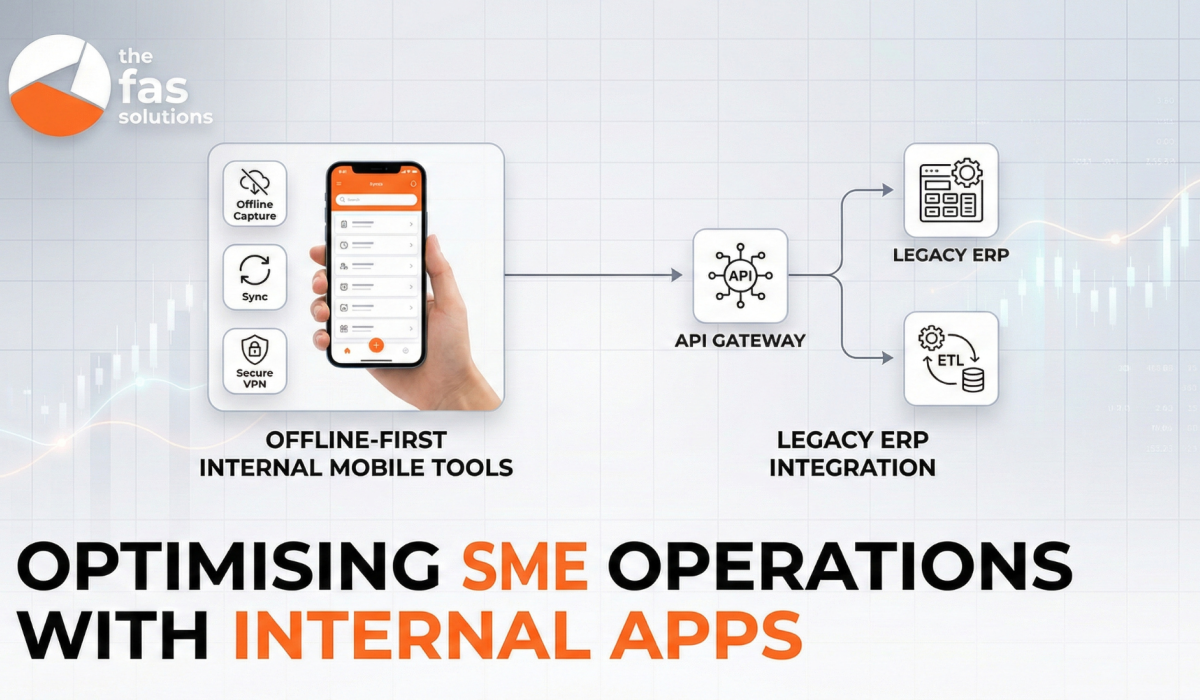
- Offline‑first architecture enables reliable field use in low‑connectivity environments.
- A lightweight API gateway and ETL service provide a secure, scalable integration with legacy ERP systems.
- Tiered BYOD policies protect data while leveraging staff‑owned devices.
- Quantitative KPIs—dispatch time, error rate, cost per transaction—prove ROI and guide scaling decisions.
Introduction
Most B2B service providers hear the same story: invest in a mobile app, and customers will flock to it. Yet, for SMEs that already struggle with internal workflow bottlenecks, the real competitive edge lies elsewhere. Internal mobile tools—applications built for field staff, logistics teams, and back‑office employees—directly reduce operational costs, accelerate data capture, and unlock hidden value in existing systems. This guide explains why an internal mobile‑first strategy outperforms a consumer‑focused approach, walks through the technical and organisational steps required, and shows how to measure success. By the end, you will understand the architecture, integration patterns, security considerations, and ROI metrics that make internal mobile solutions a sustainable advantage for growth‑stage businesses.
Understanding Operational Inefficiencies in B2B
SMEs in logistics, professional services, and field‑service industries commonly face three recurring pain points: manual data entry, delayed reporting, and fragmented communication across teams. Manual entry introduces human error and consumes hours each day; delayed reporting prevents real‑time decision making; fragmented communication slows response times to client requests. A mobile device in the hands of a field worker can capture data instantly, validate it on‑the‑spot, and push it to central systems, eliminating the need for later transcription. The impact is measurable: a FAS Solutions client in the UK reduced data‑entry errors by 45% and cut reporting latency from 48 hours to 2 hours after deploying a simple mobile capture app. Recognising these inefficiencies is the first step to reframing the mobile strategy from a marketing gimmick to a process optimisation lever.
Designing an Offline‑First Internal App
Offline‑first design acknowledges that field staff often work in environments with unreliable or no internet connectivity. The architecture consists of a local SQLite or Realm database that stores captured data until a sync window opens. When connectivity resumes, the app sends a batch of changes to a cloud gateway using incremental sync (e.g., JSON Patch). Conflict resolution follows a deterministic rule: the most recent timestamp wins, or a manual review queue is presented for ambiguous cases. Security is baked in from the start: data is encrypted at rest, and authentication tokens are cached securely. For developers, this pattern reduces complexity compared to a pure real‑time model because you can test the entire user flow without network mocks. The result is an app that feels responsive, works in remote locations, and synchronises reliably when the connection stabilises.
Integrating Mobile Data Capture with Legacy ERP Systems
Many SMEs rely on legacy ERP platforms that were not designed for modern mobile inputs. A pragmatic integration pattern involves three layers: (1) a lightweight API gateway that accepts JSON payloads from the mobile app, (2) an ETL service that maps captured fields to ERP tables, and (3) a validation engine that checks business rules (e.g., duplicate orders, out‑of‑range quantities). The gateway can be built with FastAPI or a serverless function, exposing a secure endpoint (HTTPS with client‑certificate). The ETL uses a scheduled job to batch‑process incoming data, inserting or updating records while logging any rejections for manual review. This approach preserves existing ERP workflows, avoids costly full‑stack replacements, and delivers near‑real‑time data visibility. A case study from FAS Solutions shows a UK logistics firm achieved a 22% reduction in order‑processing time after implementing this integration pattern for driver‑reported deliveries.
BYOD (Bring Your Own Device) Security Policies for SMEs
Allowing staff to use personal smartphones introduces risk but also reduces hardware costs. A tiered BYOD policy works best for SMEs: (1) Enforce device encryption (iOS/Android native), (2) Require a corporate VPN or zero‑trust network access (ZTNA) for all app traffic, (3) Deploy mobile device management (MDM) to enforce app whitelisting and remote wipe capability, (4) Use containerised app solutions so corporate data stays isolated from personal apps, and (5) Conduct quarterly security audits. These measures address the primary concerns—data leakage, unauthorised app installation, and lost devices—without demanding a full corporate device fleet. The policy also aligns with the one‑hour support guarantee, as device‑level issues can be escalated quickly through the same support channel.
Measuring Impact and Scaling the Solution
ROI for internal mobile tools is best tracked with a blend of operational and financial metrics. Start with baseline KPIs: average dispatch time, number of manual data entries per day, and error rate. After deployment, monitor: (a) reduction in manual entries, (b) time‑to‑insight (the interval between data capture and ERP update), (c) cost per transaction, and (d) employee satisfaction scores. A simple spreadsheet or a BI dashboard can visualise these trends. Scaling involves a phased rollout: pilot with a single department, gather feedback, refine the integration, then expand to adjacent units. The one‑hour support guarantee ensures that any technical hiccups are resolved quickly, preventing bottlenecks. Continuous improvement loops—such as monthly sync‑quality reviews and quarterly security audits—keep the solution aligned with evolving business needs.
Conclusion: From Experiment to Sustainable Advantage
An internal mobile‑first strategy transforms operational friction into measurable efficiency gains. By focusing on tools that streamline data capture, offline resilience, and secure integration with existing ERP systems, SMEs can achieve faster decision cycles, lower error rates, and a clearer path to growth. The steps outlined—identifying pain points, architecting offline‑first apps, integrating with legacy platforms, securing BYOD environments, and rigorously tracking impact—provide a repeatable framework that respects both technical constraints and business budgets. If you recognise the signs of operational inefficiency in your own organisation, the next logical move is to schedule a free consultation with FAS Solutions. Our 14‑year track record, one‑hour support guarantee, and transparent pricing make it straightforward to explore how internal mobile solutions can become a sustainable competitive advantage.
Conclusion
Adopting an internal mobile‑first approach is not a speculative experiment; it is a proven method to unlock hidden value in SME operations. By addressing core inefficiencies, building resilient offline apps, and integrating securely with existing ERP infrastructure, businesses can achieve measurable ROI without overspending on consumer‑focused features. The outlined framework, grounded in real‑world experience and supported by transparent security policies, equips decision‑makers with the confidence to move from pilot to enterprise‑wide implementation.
Food for Thought
If you notice that field staff spend hours each day manually entering data, consider how an internal mobile capture app could eliminate that bottleneck without requiring a new customer portal.
When planning a BYOD rollout, ask yourself whether the organisation already has device encryption policies; if not, that gap becomes the first security priority.
Think about the last time a delayed report impacted a client relationship; an offline‑first app that syncs data automatically could have prevented that delay.
Frequently Asked Questions
What are the typical costs of developing an internal mobile app for a SME?
Costs vary by scope but generally range from £5,000 to £30,000 for a full‑cycle project, including design, development, integration, and security testing. FAS Solutions offers a free consultation to clarify exact pricing based on your specific workflow.
Can an offline‑first app work with real‑time reporting requirements?
Yes, but the reporting cadence must be defined in advance. The app stores data locally and syncs during scheduled windows (e.g., nightly or when connectivity returns). This approach delivers near‑real‑time data without sacrificing field usability.
How do we ensure data consistency when syncing with a legacy ERP?
Implement a deterministic conflict‑resolution rule (most recent timestamp wins) and a validation layer that checks business constraints before committing changes. Periodic manual review of rejected records prevents hidden inconsistencies.
What security certifications does FAS Solutions hold for BYOD policies?
Our internal security framework aligns with ISO/IEC 27001 controls, and we have successfully passed external audits for data encryption, device management, and network access policies.
How long does it take to see measurable ROI after deployment?
Most clients observe a reduction in manual errors within the first two weeks and see financial impact in monthly reporting cycles after three months of steady usage.
Is a BYOD policy compatible with GDPR compliance?
When combined with device encryption, VPN, and data‑loss‑prevention controls, a BYOD policy can meet GDPR requirements for data protection and consent management.
Can we integrate multiple mobile apps into the same ERP instance?
Yes, the API gateway approach supports multiple endpoints, each with its own payload schema. The ETL layer normalises data into a common ERP model, allowing phased integration of additional apps without redesigning the core ERP.