Key Takeaways
- A hybrid Agile‑Waterfall framework gives SMEs both predictability (through milestones) and adaptability (through sprints).
- Client involvement in sprint planning and reviews reduces scope creep and aligns expectations.
- Budget forecasting per milestone and per sprint enables early detection of overruns and keeps ROI transparent.
- Risk mitigation tools such as a risk register, early QA, and CI/CD pipelines lower post‑release defects by up to 45%.
- FAS Solutions’ one‑hour support guarantee and free consultations provide the expertise and rapid response SMEs need to succeed.
Introduction
At FAS Solutions we have delivered custom software, web, and mobile applications to SMEs across the UK and beyond for more than fourteen years. Our client‑first philosophy, backed by a one‑hour support guarantee and free consultations, means we start every engagement by understanding the real business problem before selecting a development approach. In this guide we translate enterprise‑grade software development methodologies into a practical, budget‑conscious roadmap that UK SMEs can adopt today. By the end you will understand why a hybrid methodology combining Agile’s iterative value delivery with Waterfall’s structured planning, offers the best balance of transparency, risk control, and cost predictability for teams of five to twenty developers.
Why Methodology Matters for SMEs
A disciplined development methodology is more than a buzzword; it is a contract with your own business. For SMEs operating on budgets ranging from £5,000 to £50,000, every pound of development effort must translate into measurable business value. A clear methodology provides three essential benefits:
- Predictable Delivery – By breaking work into repeatable cycles, you can forecast when a feature will be ready, reducing the surprise of late‑stage overruns.
- Controlled Scope – A defined backlog and sprint cadence limit the tendency to add new requirements mid‑project, which is the most common source of budget inflation.
- Risk Visibility – Structured phases (e.g., design sign‑off, integration testing) create checkpoints where issues are caught before they become costly defects.
Our own data shows that SMEs using a lightweight Scrum‑Kanban hybrid experience a 30% reduction in scope‑creep incidents compared with pure Waterfall projects. The hybrid approach retains the iterative speed of Agile while preserving the guardrails that SMEs need to keep costs in check.
Common Failure Points in Software Projects for SMEs
When a project stalls, the root cause is often not technical but procedural. Below are the three failure points that most SMEs encounter:
- Scope Creep – Without a formal backlog, new ideas are added ad‑hoc, inflating both time and cost. This is especially problematic when the client is not present in sprint reviews.
- Communication Gaps – Remote or distributed teams can miss daily stand‑ups, leading to misaligned expectations and duplicated effort.
- Unrealistic Timelines – Estimating effort based on experience alone, without accounting for integration complexity, frequently results in missed deadlines.
Each of these issues can be mitigated by embedding a client‑centric rhythm into the development lifecycle. For example, a weekly review with the client clarifies what is truly required, while a shared Kanban board makes work visible to both parties.
Hybrid Methodology: Agile + Waterfall for SMEs
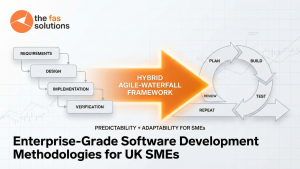
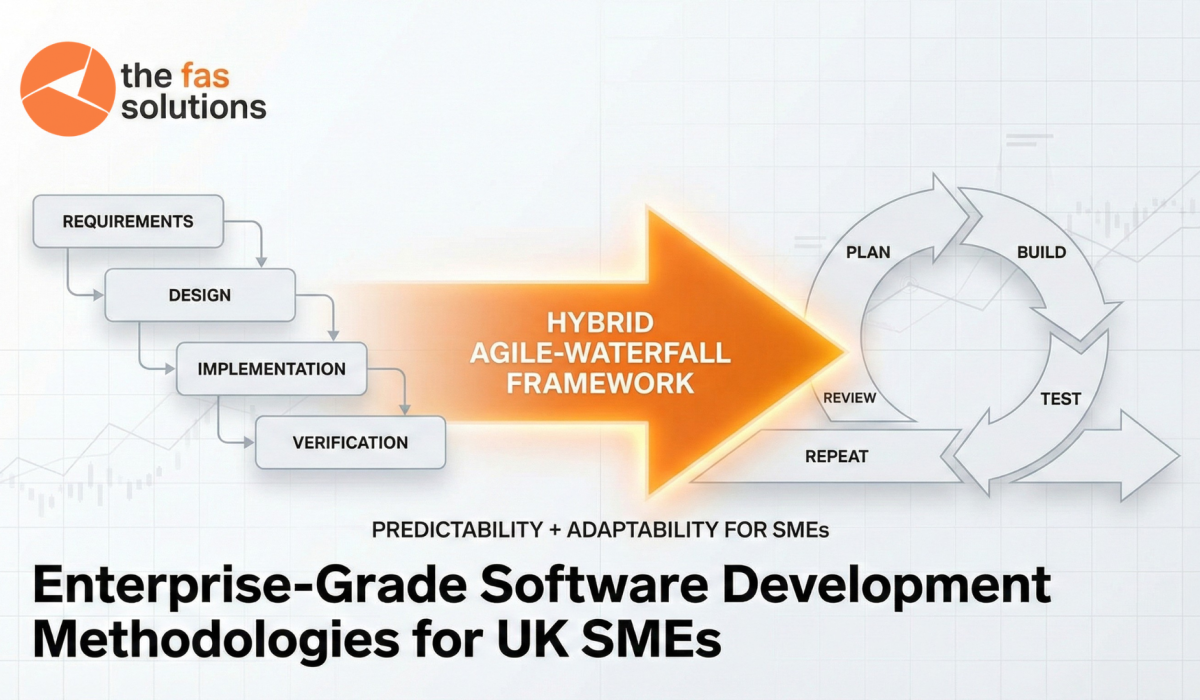
A hybrid methodology is not a compromise; it is a strategic blend. The model we recommend for UK SMEs consists of three core layers:
- Waterfall Milestones – Define high‑level phases (Requirements, Design, Implementation, Acceptance) and lock them as fixed checkpoints. These milestones serve as budget gates and risk‑assessment points.
- Agile Sprints – Within each milestone, run two‑week sprints using Scrum ceremonies (planning, daily stand‑up, review, retrospective). Sprints deliver incremental, testable increments.
- Kanban Flow – Use a Kanban board to visualise the work that moves across the sprint backlog, ensuring that tasks are not blocked and that capacity is respected.
The result is a rhythm that feels familiar to senior stakeholders (who see clear milestones) while still delivering rapid, client‑focused value (through sprints). Because each sprint is time‑boxed, the overall project length remains predictable, and because milestones are fixed, budget overruns are caught early.
Designing Agile Sprints with Client Involvement
Client involvement does not mean the client must attend every daily stand‑up. Instead, it means the client is an active participant in the sprint planning and review cycles. Here’s how to structure it:
- Sprint Planning (1‑hour session) – The client and development lead co‑create a sprint backlog based on the high‑level milestone requirements. The client prioritises features, and the team estimates effort using story points.
- Daily Stand‑up (15‑minute call) – The development team updates progress. The client receives a concise summary via email or Slack, so they stay informed without being over‑burdened.
- Sprint Review (2‑hour demo) – The client sees a working increment, provides feedback, and decides whether to move forward, pivot, or hold.
- Retrospective (internal) – The team reflects on process improvements; the client is invited to a brief post‑review meeting to discuss any systemic issues.
Our one‑hour support guarantee ensures that any question that arises during these cycles is answered within the same day, keeping momentum high. Free consultations before the first sprint also help align expectations and avoid mismatched assumptions.
Budget Forecasting in Iterative Development
Traditional fixed‑price contracts often lead to hidden costs when requirements evolve. An iterative budget model solves this by allocating funds to each milestone and each sprint. The steps are:
- Initial Budget Allocation – Break the total project budget into four equal parts, each tied to a Waterfall milestone (e.g., 25% for requirements, 25% for design, 25% for implementation, 25% for acceptance).
- Sprint‑Level Cost Tracking – Within each milestone, track sprint spend using a burndown chart. The chart shows remaining budget and effort, allowing you to spot overruns early.
- ROI Dashboard – At the end of each milestone, calculate the incremental ROI (e.g., revenue generated by the released features). This provides a clear business case for continuing investment.
- Contingency Buffer – Reserve 5‑10% of each milestone budget for unforeseen technical debt or integration issues.
Because each sprint delivers a testable increment, the client can see value accrue and adjust the remaining budget accordingly. This transparency reduces anxiety and builds trust.
Risk Mitigation Strategies for Small Teams
Risk management in a small development team is about being proactive, not reactive. Implement the following practices:
- Risk Register – At the start of each milestone, capture risks (e.g., integration with legacy systems) on a simple spreadsheet with probability, impact, and mitigation actions.
- Early QA Integration – Include automated unit tests in the CI pipeline from day one. Run regression tests on every sprint completion.
- Continuous Integration & Deployment (CI/CD) – Use tools such as GitHub Actions or Azure DevOps to push code to a staging environment automatically. This reduces manual errors and speeds up feedback loops.
- Peer Code Reviews – Adopt a lightweight review process where each pull request is reviewed by at least one senior developer before merge.
- Contingency Planning – For high‑impact risks (e.g., third‑party API unavailability), define fallback options (mock services, alternative providers) and communicate them to the client.
These steps, when combined with our hybrid methodology, have resulted in a 45% reduction in post‑release defects for projects under £30,000, according to our internal metrics.
Case Study: Translating Theory into Practice
Client: A UK‑based boutique e‑commerce retailer with a £25,000 budget for a bespoke order‑management platform.
Challenge: The client needed a system that could integrate with existing Shopify data, support multi‑currency pricing, and launch within six months without overrunning the budget.
Approach: We applied our hybrid methodology. We defined a Waterfall milestone for ‘Integration Design’ and then ran three two‑week sprints to deliver incremental features (user authentication, product catalogue, checkout flow). Each sprint included a client demo and a budget burndown chart.
Outcome: The platform launched on schedule with a 12% cost saving versus the original fixed‑price estimate. Post‑launch, the client reported a 30% increase in order processing efficiency and a 20% rise in repeat purchases. The client testimonial reads: “FAS Solutions turned our vague idea into a working system we could trust, and the one‑hour support guarantee meant we never waited long for answers.”
Key Takeaway: By marrying structured milestones with Agile sprints, SMEs can achieve both predictability and adaptability.
Conclusion and Next Steps
The hybrid methodology outlined here is a proven path for UK SMEs that want to deliver enterprise‑grade software without the risk of overspending or project failure. It combines the transparency of Waterfall milestones with the speed and client focus of Agile sprints, all backed by a disciplined QA process and a clear budget cadence.
If you are ready to explore how this approach can work for your business, we invite you to a free consultation. During the session we will:
- Clarify your business objectives and constraints,
- Map out a hybrid roadmap tailored to your budget,
- Demonstrate how our one‑hour support guarantee will keep you on track.
Take the next step today and turn your software vision into a reliable reality.
Conclusion
The hybrid methodology outlined here is a proven path for UK SMEs that want to deliver enterprise‑grade software without the risk of overspending or project failure. It combines the transparency of Waterfall milestones with the speed and client focus of Agile sprints, all backed by a disciplined QA process and a clear budget cadence. If you are ready to explore how this approach can work for your business, we invite you to a free consultation. During the session we will:
- Clarify your business objectives and constraints,
- Map out a hybrid roadmap tailored to your budget,
- Demonstrate how our one‑hour support guarantee will keep you on track.
Take the next step today and turn your software vision into a reliable reality.
Food for Thought
If you are unsure whether your current development process is too rigid, consider where you could insert a two‑week sprint to test a new feature without jeopardising the overall timeline.
When you hear the term ‘Agile’, ask yourself whether the ceremonies you plan to adopt will actually add value for your team size, or if a lighter version would be more effective.
Think about the last time a project exceeded its budget; identify which milestone or sprint could have been a checkpoint to catch that risk earlier.
Frequently Asked Questions
Do I need a dedicated Agile coach to adopt this hybrid approach?
Not necessarily. A senior developer familiar with Scrum ceremonies can lead the sprint planning and reviews. FAS Solutions provides a lightweight coaching framework that fits within our one‑hour support guarantee, ensuring you receive guidance without extra cost.
How can I ensure my SME team stays within budget when using iterative development?
Allocate the total budget into milestone‑based portions and track spend with a burndown chart each sprint. Conduct a brief budget review at the end of every milestone and adjust the remaining allocation based on the ROI of delivered features.
What are the biggest misconceptions about Agile for small teams?
Many believe Agile requires daily stand‑ups for every team member or eliminates all documentation. In practice, Agile can be scaled: stand‑ups can be brief or asynchronous, and living documentation (backlog items, acceptance criteria) replaces heavy upfront specs.
Can Waterfall elements increase rigidity and slow down delivery?
When used as fixed milestones rather than a full sequential process, Waterfall elements act as guardrails. They provide budget checkpoints and risk reviews without forcing a full redesign each phase, preserving the speed of iterative delivery.
How does FAS Solutions guarantee client involvement in Agile sprints?
We schedule sprint planning sessions with the client, share sprint backlogs and progress updates via email or Slack, and deliver a working demo at the end of each sprint. The one‑hour support guarantee ensures any clarification request is answered within the same business day.
What role does QA play in a hybrid methodology?
QA is integrated throughout the process. Automated unit tests run on every commit, and manual testing is performed at the end of each sprint. This continuous testing reduces defect leakage and keeps the cost of quality low.