Key Takeaways
- Modernization should be viewed as a business continuity strategy, not just a feature upgrade.
- A phased, dual‑write migration guarantees zero operational downtime for end‑users.
- Risk mapping and stakeholder communication reduce uncertainty and align expectations.
- ROI can be quantified by avoided downtime cost, licensing savings, and productivity gains.
- FAS’s 14+ years of experience, one‑hour support guarantee, and free consultations build trust from the outset.
Introduction
Many SMEs today rely on legacy IT systems that have served them well for years. Yet, those same systems become a hidden source of risk: security gaps widen, scalability limits growth, and hidden maintenance costs erode profit margins. The temptation is to view modernization as a simple upgrade—replace the old with the new and add features. In reality, for most growth‑stage businesses, the decisive metric is not feature richness but continuity: the ability to operate without interruption while the transition unfolds. This is where the FAS Solutions approach diverges from the generic ‘upgrade‑your‑systems’ narrative. By framing modernization as a business continuity strategy, we prioritise zero operational downtime above all else. Our methodology has been honed over 14 years of delivering custom software, web, and mobile solutions to SMEs across the UK and globally. The result is a risk‑averse migration framework that lets you modernise with confidence, backed by a one‑hour support guarantee and free consultations that ensure you never feel left alone.
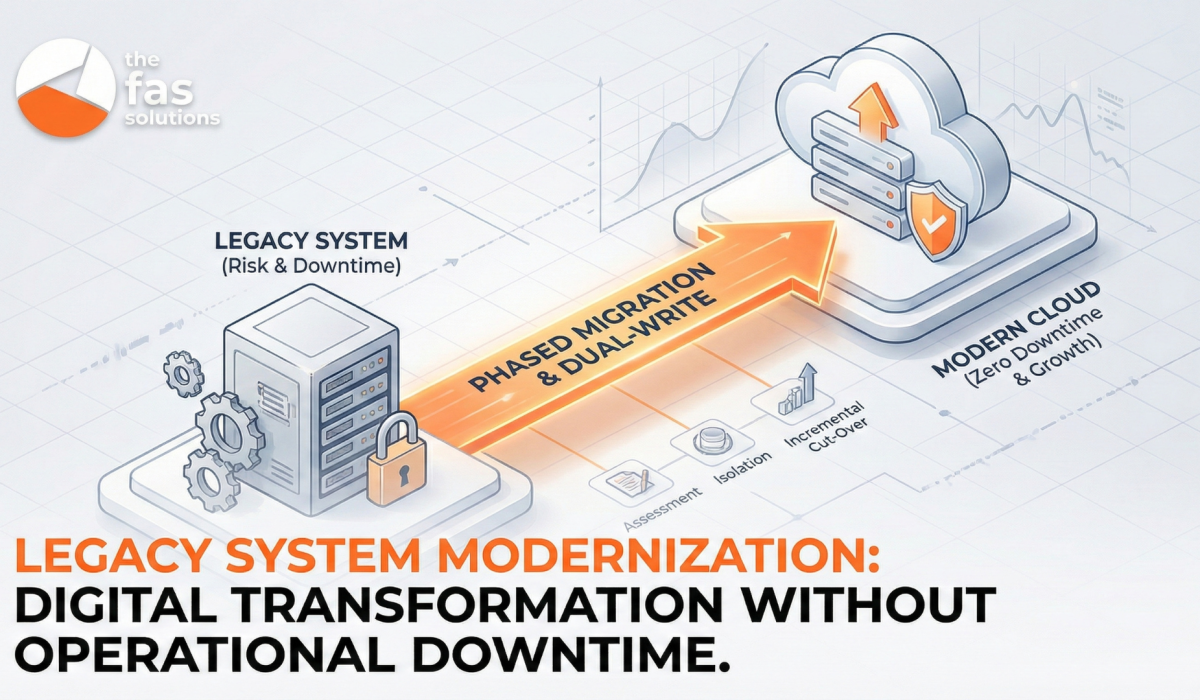
Phase 1 – Assessment & Risk Mapping
The first step in any migration is understanding what you have and what could go wrong. FAS conducts a comprehensive inventory that records every application, data source, integration point, and business process tied to the legacy environment. This inventory is paired with a risk matrix that scores each component on three dimensions: security exposure, scalability limitation, and hidden maintenance cost. By visualising these risks, you gain a clear picture of where the migration will generate the most disruption. The assessment also uncovers hidden dependencies—legacy interfaces that are rarely documented but critical to day‑to‑day operations. Addressing these early prevents surprise failures during later phases. For SMEs with limited internal expertise, this stage can be completed in a two‑week sprint, after which a concise risk report is delivered. The report includes concrete recommendations such as prioritising high‑risk modules for isolation, scheduling low‑impact modules for later migration, and identifying data sets that require special handling. The outcome is a roadmap that is transparent, realistic, and aligned with your budget.
Phase 2 – Isolation & Dual‑Write Architecture
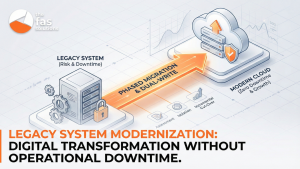
Once the assessment is complete, the next logical move is to protect the business from data loss while the new platform is being built. FAS implements a dual‑write architecture that writes every transaction to both the legacy database and a cloud‑based replica in near real time. This architecture is achieved through lightweight middleware that captures change data capture (CDC) events and forwards them to the cloud destination without altering the existing workflow. Because the legacy system continues to serve production traffic, users experience no interruption. Meanwhile, the cloud replica can be tested, validated, and tuned in parallel. This phase typically lasts three to four weeks, depending on data volume and integration complexity. The dual‑write model also provides a safety net for rollback: if a discrepancy is detected, the system can revert to the legacy store while the cloud copy is reconciled. Importantly, the dual‑write approach does not require a full‑scale data migration before cut‑over, which eliminates the most common source of downtime anxiety.
Phase 3 – Incremental Cut‑Over & Validation
With data integrity secured, the migration moves into the cut‑over stage. Instead of a big bang lift‑and‑shift, FAS uses an incremental approach: each business function is migrated one at a time, while the dual‑write layer remains active until the final function is switched off. For example, a finance module might be migrated first, followed by CRM, then the e‑commerce platform. Each cut‑over is preceded by a validation checklist that confirms data consistency, functional parity, and performance benchmarks. Validation includes automated regression tests, manual user acceptance testing (UAT), and a brief operational window where both systems run side‑by‑side. Only after passing all validation criteria does the legacy component go offline. The incremental cut‑over reduces risk to a manageable level—typically 5‑10 % of total migration risk—while guaranteeing zero operational downtime for end‑users. This method also allows the business to continue generating revenue throughout the transition, which is a key trust signal for our clients.
Stakeholder Management & Communication
Modernization projects often stall because stakeholders are not aligned on expectations, timelines, or responsibilities. FAS mitigates this by establishing a lightweight stakeholder management plan that maps three concentric circles: core technical team (inner), business owners and decision‑makers (middle), and external partners such as vendors or regulatory bodies (outer). Communication channels are predefined: a weekly status email for the core team, a bi‑weekly executive briefing for the middle circle, and a monthly stakeholder forum for the outer circle. Decision points are clearly marked on the roadmap, and each phase includes a ‘go/no‑go’ gate review with documented criteria. This approach respects the limited bandwidth of SME leaders while ensuring that critical risks are escalated promptly. By normalising uncertainty—explicitly stating that risk is expected and will be managed through these gates—FAS reduces the anxiety that often accompanies large IT initiatives.
Calculating ROI: Beyond Feature Count
ROI for legacy modernization is frequently mis‑calculated as a simple cost‑benefit of new features versus old ones. The FAS framework reframes ROI around three measurable outcomes: (1) avoided downtime cost, (2) reduced licensing and maintenance expenses, and (3) productivity gains from modern tooling. Downtime avoidance is quantified by estimating the revenue loss per hour of system unavailability (often £10,000–£30,000 for SMEs) and multiplying by the projected number of hours saved. Licensing cost savings are captured by replacing perpetual licences with subscription models, which typically reduce annual spend by 20‑40 %. Productivity gains are measured through developer velocity improvements—FAS’s high‑self‑assessment of 98 % web development success translates to faster feature delivery cycles. Together, these metrics provide a concrete ROI figure that can be presented to board members. The ROI model also includes a sensitivity analysis that shows how variations in downtime estimates affect the overall return, ensuring transparency about assumptions.
Conclusion
Modernizing a legacy system is not a technical swap; it is a strategic decision to protect your business continuity while unlocking new capabilities. By following the FAS phased, risk‑averse migration framework, you can achieve zero operational downtime, preserve data integrity, and generate a measurable ROI that aligns with your growth objectives. The approach is built on 14 years of experience, a one‑hour support guarantee, and free consultations that place the client’s needs first. If you are ready to move beyond the fear of disruption and toward a confident, continuity‑first transformation, contact FAS Solutions for a no‑obligation assessment. Our team will walk you through the exact steps, answer any remaining questions, and help you design a migration plan that fits your budget and timeline.
Food for Thought
If you are unsure whether your legacy system’s downtime risk outweighs its cost, consider mapping each function’s revenue impact per hour of outage and compare it to the projected migration timeline.
When planning stakeholder engagement, ask yourself: which decision points can be deferred without jeopardising the migration, and which require senior leadership sign‑off?
Frequently Asked Questions
How long does a typical FAS migration take for a mid‑size SME?
A phased migration for a mid‑size SME (£5,000‑£50,000 budget) typically spans 8‑12 weeks, broken into the five phases outlined above. The timeline is flexible and can be compressed if business urgency demands, but we always prioritise zero downtime over speed.
What happens if data discrepancies are found during validation?
If a discrepancy is detected, the dual‑write layer automatically flags the issue and triggers a reconciliation process. The legacy system remains operational while the cloud copy is corrected. This ensures that no user transaction is lost and that the cut‑over can proceed only after the data is fully aligned.
Can FAS handle migrations that involve sensitive data subject to GDPR?
Yes. FAS follows a strict data‑handling protocol that includes encryption at rest and in transit, role‑based access controls, and a documented data‑transfer impact assessment. All migration steps are logged for auditability, meeting GDPR compliance requirements.
Do you provide post‑migration support?
Absolutely. Our one‑hour response guarantee applies to the entire migration lifecycle, including the first 90 days after cut‑over. We also offer optional managed services contracts for ongoing monitoring and optimisation.
How is the ROI calculated if my business does not track downtime cost explicitly?
We can estimate downtime cost using industry benchmarks (e.g., average revenue loss per hour for your sector) and combine it with your historical incident data. The final ROI model is transparent and can be adjusted as you acquire more precise internal metrics.
What are the typical cost components of a FAS migration?
Costs are broken down into assessment (20 %), isolation and dual‑write (30 %), incremental cut‑over (35 %), stakeholder management (10 %), and optional post‑migration support (5 %). This breakdown helps you see where value is added at each stage.
How do you ensure stakeholder buy‑in throughout the project?
Our stakeholder management plan includes regular briefings, clear decision gates, and documented outcomes from each phase. By normalising uncertainty and providing concrete progress metrics, we keep expectations realistic and maintain confidence.