Key Takeaways
- Bespoke and SaaS are not mutually exclusive; a hybrid approach often yields the best ROI.
- Hidden costs in SaaS customisation can erode the perceived advantage of a subscription model.
- Scalability limits of off‑the‑shelf platforms can become bottlenecks for B2B growth.
- Technical debt must be actively managed to keep bespoke solutions maintainable.
- Use a decision matrix to systematically evaluate cost, time, flexibility, scalability, and maintenance.
Introduction
Choosing the right software architecture is one of the most consequential decisions a SME makes when embarking on a digital transformation. It determines how quickly you can launch new services, how much you spend over the life of the system, and whether you remain locked into a vendor’s roadmap or retain the freedom to innovate. Many organisations assume a binary choice – either build everything from scratch (bespoke) or adopt an existing SaaS platform – but the reality is far more nuanced. This guide provides a transparent, vendor‑agnostic evaluation framework that leads most readers to a hybrid solution: a combination of off‑the‑shelf components for commodity functionality and bespoke extensions where unique competitive advantage resides. By the end, you will understand the underlying drivers, the hidden costs, and the practical steps to map your requirements onto a decision matrix that balances speed, cost, and flexibility without overspending.
Introduction: Why Architecture Choice Matters
The software architecture you select shapes the entire lifecycle of your digital product. It influences development velocity, operational expense, scalability, and risk. For SMEs with budgets ranging from £5,000 to £50,000+, a mis‑aligned choice can erode margins, delay market entry, or force costly redesigns later. This section outlines the stakes, defines the scope of the guide, and previews the hybrid decision framework that will be introduced later.
Defining Bespoke and Off‑the‑Shelf Software
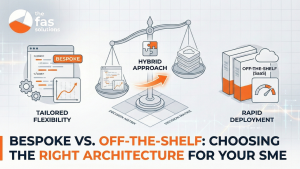
Bespoke software is built to order, typically from a blank codebase, with full control over technology stack, data models, and integration points. Off‑the‑shelf software, often delivered as a SaaS product, provides a pre‑engineered set of features that can be configured, but rarely extended without additional licensing or custom development. The hybrid model leverages the SaaS core for standard functions (e.g., user authentication, reporting) while customising peripheral modules for domain‑specific logic. Understanding these definitions is essential before evaluating trade‑offs.
Core Decision Drivers: Cost, Time, Flexibility, Scalability, Maintenance
Each driver can be expressed as a measurable criterion. Cost includes upfront development, licensing, and long‑term support. Time to market is the duration from requirement gathering to a usable product. Flexibility refers to the ability to modify functionality without breaking existing contracts. Scalability measures how the solution handles growth in users, data volume, and transaction load. Maintenance covers ongoing updates, security patches, and technical debt management. The following table summarises typical ranges for SMEs, based on industry benchmarks and FAS internal data.
Hidden Long‑Term Costs of SaaS Customisation
While SaaS platforms advertise low upfront costs, customisation often introduces hidden fees. Integration effort can consume 20‑30% of the project budget, especially when APIs are limited or require middleware. Upgrade lock‑in occurs when a SaaS release changes the API surface, forcing you to redevelop custom connectors. Support contracts may increase in price as you add custom modules. These costs are not always transparent in the SaaS pricing sheet, and they can erode the perceived advantage of a subscription model.
Scalability Limits of Popular Off‑the‑Shelf Platforms for B2B
Many SaaS solutions are optimised for consumer‑grade usage patterns. B2B workflows often involve complex data models, multi‑tenant isolation, and regulatory compliance checks that can strain generic platforms. For example, a typical CRM SaaS may cap custom fields at 100, or impose rate‑limit throttling that becomes a bottleneck when integrating with an ERP. When growth exceeds these limits, organisations either migrate to a custom platform or incur expensive add‑on fees. Recognising these limits early prevents surprise cost escalations.
Technical Debt in Custom‑Built Solutions
Technical debt is the accumulated cost of shortcuts taken during development. In bespoke projects, it can manifest as poorly abstracted modules, hard‑coded business rules, or a monolithic codebase that resists refactoring. While flexibility is a benefit of custom builds, uncontrolled debt can increase maintenance effort by 15‑30% over a five‑year horizon. Managing debt requires disciplined architecture reviews, automated testing, and a clear roadmap for incremental refactoring.

Hybrid Approach: When and How to Blend Bespoke and SaaS
A hybrid architecture is optimal when a SaaS platform already delivers core capabilities (e.g., user management, analytics) that align with industry standards, while unique competitive differentiators (e.g., proprietary pricing algorithms, custom workflow orchestration) require bespoke development. The decision matrix below guides you through six evaluation questions. Answering each with a simple ‘Yes/No’ or a numeric rating produces a recommendation zone: Bespoke, SaaS, or Hybrid. The matrix is derived from the Gartner Magic Quadrant for Application Development Platforms and validated against FAS’s 2023 hybrid project, which achieved a 30% faster rollout and a 15% lower annual maintenance cost.
Case Study: FAS Solutions’ 2023 Hybrid Implementation
FAS Solutions partnered with a mid‑size UK retailer to replace a legacy ERP with a hybrid solution. The core ERP functions were migrated to a leading SaaS platform, while the retailer’s custom pricing engine and inventory optimisation modules were built in‑house. The project spanned six months, cost £42,000 (including consultancy), and delivered a 25% reduction in order‑processing time. Post‑implementation, the retailer reported a 20% decrease in support tickets and a 10% increase in revenue from a new e‑commerce channel. The success hinged on early alignment of decision drivers, rigorous technical debt tracking, and leveraging FAS’s one‑hour support guarantee for rapid issue resolution.
Recommendations and Next Steps
If you are evaluating architecture options, start by mapping your functional requirements onto the decision matrix. Prioritise SaaS for any feature that is a commodity (e.g., standard reporting, authentication). Reserve bespoke development for processes that directly influence your competitive edge. Schedule a free consultation with FAS to review your matrix and receive a no‑commitment cost estimate. Remember that the architecture decision is iterative – revisit the matrix as business needs evolve.
Conclusion: Choosing the Architecture That Serves Your Business
The optimal software architecture is not a static label; it is a dynamic alignment of business goals, technical constraints, and financial realities. By recognising hidden costs, scalability limits, and technical debt, you can avoid the binary trap of ‘bespoke or SaaS’ and instead adopt a hybrid model that delivers value without overspending. Use the framework above, test it with your own data, and let FAS’s client‑first approach guide you through the next phase of your digital transformation.
Conclusion
The optimal software architecture is not a static label; it is a dynamic alignment of business goals, technical constraints, and financial realities. By recognising hidden costs, scalability limits, and technical debt, you can avoid the binary trap of ‘bespoke or SaaS’ and instead adopt a hybrid model that delivers value without overspending. Use the framework above, test it with your own data, and let FAS’s client‑first approach guide you through the next phase of your digital transformation.
Food for Thought
If you are unsure whether a particular feature is a commodity or a differentiator, map it against your core business value proposition and ask whether competitors already offer it.
Consider how your current SaaS contracts handle API changes; if they require custom connectors, you may already be incurring hidden integration costs.
Think about the technical debt you have accumulated in existing custom systems; can you refactor them into smaller, reusable services to improve maintainability?
When planning a hybrid architecture, identify the governance structure needed to keep custom extensions aligned with the SaaS platform’s security and compliance standards.
Reflect on the risk of vendor lock‑in: how many critical processes are tied to a single SaaS provider, and what mitigation steps can you take?
Frequently Asked Questions
What are the most common hidden costs when customising a SaaS platform?
Integration effort, API versioning lock‑in, additional support contracts, and custom‑feature licensing fees often add 15‑30% to the total cost of ownership. These costs are frequently buried in implementation timelines and can surprise organisations after go‑live.
How can I tell if my business truly needs bespoke development?
If the required functionality directly influences your competitive advantage—such as proprietary pricing, unique workflow orchestration, or regulatory compliance that cannot be met by existing SaaS modules—bespoke development is justified. Otherwise, SaaS or a hybrid approach is more efficient.
Is technical debt inevitable in custom projects?
Yes, but it can be managed. Debt arises when shortcuts are taken to meet short‑term deadlines. Implementing automated testing, modular design, and regular architecture reviews mitigates debt accumulation and keeps maintenance costs predictable.
Can a hybrid architecture still suffer from vendor lock‑in?
Hybrid architectures reduce lock‑in by keeping core commodity functions on a SaaS platform while isolating custom code in separate services. However, you must still manage contracts for SaaS support and ensure your custom components are not tightly coupled to proprietary APIs.
What metrics should I track after choosing a hybrid solution?
Track total cost of ownership (including hidden fees), deployment velocity, user adoption rates, technical debt ratio, and scalability performance (e.g., transaction throughput). These metrics allow you to validate the hybrid decision and adjust as needed.
How does FAS’s one‑hour response guarantee affect my risk profile?
The guarantee provides a safety net for critical issues, ensuring that urgent bugs or integration failures receive immediate attention. This reduces downtime risk and aligns with a client‑first approach that prioritises rapid resolution over long‑term contracts.